
- Applicants
- Main applicant + spouse dependent
- Nationality
- Indian
- Client’s Company
- India
- Applied From
- Spain
- Submission Date
- February 7, 2026
- Resolution Date
- March 10, 2026
The Case & Challenge
The main applicant, an Indian Application Developer, applied for Spain’s Digital Nomad Visa from within Spain together with his spouse as a dependent. Both applications were submitted on February 7, 2026, with the spouse’s application formally linked to the main applicant’s DNV application.
The applicant had been providing remote software development services to a company in India since March 2023. His professional agreement covered software development, maintenance, testing, deployment, technical documentation, and coordination with remote teams, while also confirming that his work was performed entirely remotely.
During processing, UGE issued a requerimiento to the main applicant covering two points. They requested an up-to-date official commercial registry certificate for the foreign company and an apostilled and sworn-translated certificate proving his registration as self-employed in India.
The self-employment requirement was the more country-specific part of the case. India does not issue a document directly equivalent to Spain’s alta de autónomo, so we needed to demonstrate his independent professional status using documentation recognized within the Indian system.
The Strategy & Solution
To address the self-employment requirement, we submitted the applicant’s GST Registration Certificate, duly apostilled and accompanied by a sworn Spanish translation. This established his fiscal registration and activity as a self-employed professional/proprietor in India.
For the company documentation, we provided an apostilled and sworn-translated Certificate of Incorporation, supplemented by a current master-data extract from India’s Ministry of Corporate Affairs confirming that the company remained active.
Rather than adding unnecessary documentation, the response concentrated on the two issues UGE had specifically raised and clearly connected each document to the corresponding requirement.
Meanwhile, the spouse’s dependent application was supported by the necessary documentation establishing the family relationship and her eligibility as a dependent under the main applicant’s DNV application.
The Outcome
The requerimiento was successfully resolved, resulting in approval for both the main applicant and his spouse.
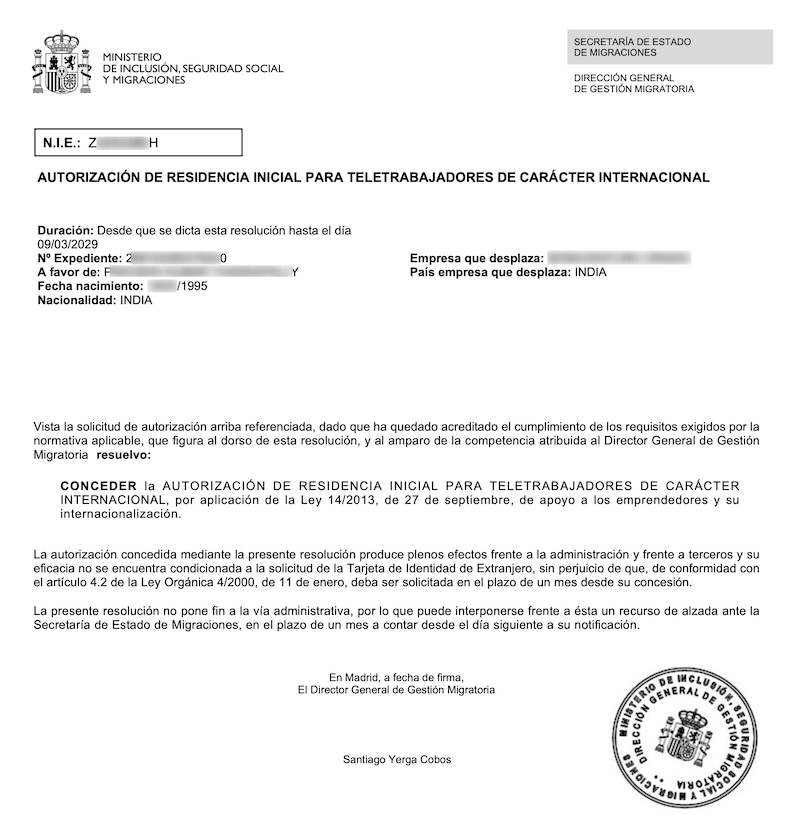
On March 10, 2026, the main applicant was granted his Initial Residence Authorization for International Teleworkers, valid until March 9, 2029.
His spouse was also approved on March 10, 2026, receiving her Initial Residence Authorization as a family member of an international teleworker. Her authorization is linked to the main applicant’s permit and is likewise valid until March 9, 2029.
This case shows how a requerimiento affecting the main applicant can have implications for the family application as a whole. By resolving UGE’s questions regarding his Indian self-employment registration and the current status of the foreign company, we were able to move the case forward successfully and secure three-year residence approvals for both husband and wife.
Want the same outcome?
Tell us about your case and we'll map out the fastest route to approval.