
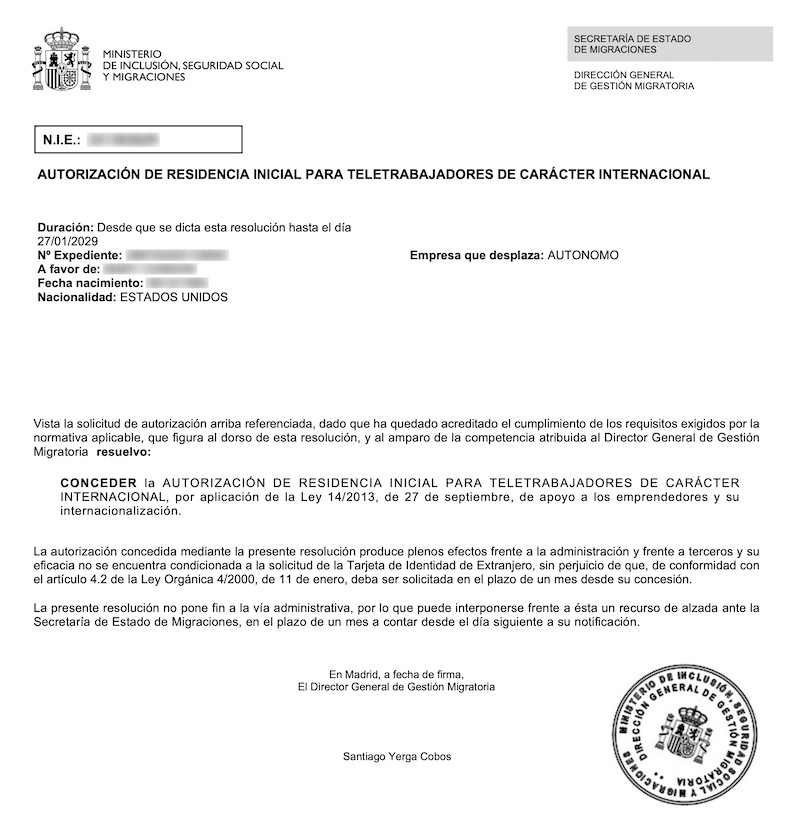
Approved
American Educational Consultant and Bookkeeper (Client Company in Minnesota, USA)
- Applicants
- Lone applicant
- Nationality
- American
- Client’s Company
- USA
- Applied From
- Spain
- Submission Date
- December 26, 2025
- Resolution Date
- January 28, 2026
The Case & Challenge
This represented one of our most complex corporate structuring cases. The applicant, an American educational consultant and bookkeeper, applied for the Spain Digital Nomad Visa (DNV) as an independent contractor of her own business structures. She owned two separate Limited Liability Companies (LLCs) registered in Minnesota, USA.
This setup presented two severe administrative hurdles when the Unidad de Grandes Empresas (UGE) issued a requerimiento on the 19th working day of the review:
- Income Aggregation and Corporate Scrutiny: Income from a single LLC was insufficient to meet the strict Spanish minimum financial threshold; therefore, both entities had to be included. However, one LLC was registered directly under her personal name, which triggered intense evaluator scrutiny regarding corporate distinction and self-contracting legitimacy.
- The “Three-Month” Contract Requirement: The UGE explicitly requires that a client company must maintain an active commercial relationship with the applicant for at least three months prior to application. While her first LLC easily met this requirement, her second LLC had signed its service contract with her only 1.5 months before submission, creating a technical gap that threatened immediate rejection.
The Strategy & Solution
To salvage the application, our team constructed an ironclad response that legally connected her operational history and decoupled her personal identity from her business entities.
- Proving Corporate Separation: To satisfy the ownership query for the personally named LLC, we supplemented her official state registration files with a comprehensive Single Member Operating Agreement alongside detailed corporate banking statements. This legally proved the distinct financial existence of the entity despite its name.
- Overcoming the Contract Seniority Gap: To address the 1.5-month contract shortfall on the second LLC, we uncovered historical banking and client records proving that she had actually been providing professional services to the end-clients of this second entity for well over a year prior to forming the formal agreement. We structured these invoices, bank transcripts, and continuous history into a clear, unified timeline. We capped this off with a signed explanation letter mapping her multi-year operational activity to show the evaluator that the commercial relationship far exceeded the mandatory 3-month legal minimum.
The Outcome
The comprehensive strategic documentation completely resolved the evaluator’s concerns. The UGE accepted the combined corporate income from both LLCs and fully validated the continuous business history as meeting the three-month seniority standard.
On January 28, 2026, the application achieved a full Approval! This complex victory demonstrates that even when navigating multi-LLC self-employment, short-term contracts, or strict income aggregation, a meticulously structured corporate paper trail can unlock success.
Want the same outcome?
Tell us about your case and we'll map out the fastest route to approval.