
- Applicants
- Lone applicant
- Nationality
- Indian
- Client’s Company
- India
- Applied From
- Within Spain
- Submission Date
- December 28, 2025
- Resolution Date
- February 3, 2026
The Case & Challenge
The applicant, a skilled tech professional providing remote services to a company based in India, submitted a comprehensive application for the Spain Digital Nomad Visa (DNV). Given his clear professional qualifications and contract, the application seemed perfectly positioned for a smooth review.
However, on January 26, 2026, the Unidad de Grandes Empresas (UGE) issued a requerimiento (a formal request for additional documentation). The evaluator explicitly demanded an official certificate proving registration as a self-employed worker (autónomo) in the country of origin.
The hurdle? Much like many independent contractors operating out of India, the applicant faced a major bureaucratic roadblock: India simply does not issue a direct equivalent to a European-style “self-employment certificate”.
The Strategy & Solution
To bridge this legal and structural gap, our team drafted a comprehensive explanation letter outlining the unique nature of Indian business registration. We explained that instead of a traditional freelancer registry, independent professionals operating by and for themselves in India must register through the national tax framework.
To fulfill the UGE’s requirement, we substituted the requested certificate with alternative proof:
- GST Registration Certificate: We supplied the official Goods and Services Tax (GST) certificate, legally proving active operations as a sole proprietorship.
- Legal Authentication & Compliance: The GST document was formally apostilled by the Indian Ministry of External Affairs and accompanied by a certified sworn Spanish translation (traducción jurada) to meet strict UGE standards.
The Outcome
By strategically educating the evaluator on local tax alternatives and providing a fully compliant, apostilled GST package, the UGE accepted the documentation without further hesitation.
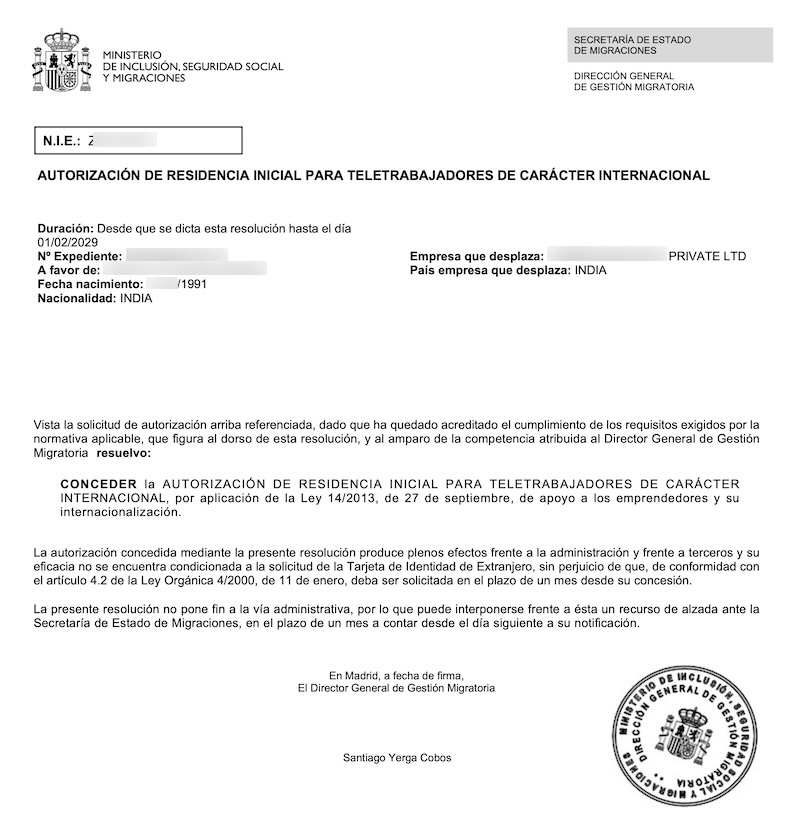
On February 2, 2026—just one week after the initial hurdle—the Digital Nomad Visa was officially Approved! The initial residency authorization as an international teleworker was granted and remains valid all the way through February 1, 2029.
This case is another fantastic reminder that navigating foreign administrative structures requires more than just submitting documents—it requires knowing exactly how to translate local business realities into terms the Spanish government trusts.
Want the same outcome?
Tell us about your case and we'll map out the fastest route to approval.