
- Applicants
- Main applicant and spouse dependent
- Nationality
- Pakistani
- Client’s Company
- Uruguay
- Applied From
- Within Spain
- Submission Date
- January 19, 2026
- Resolution Date
- February 11, 2026
The Case & Challenge
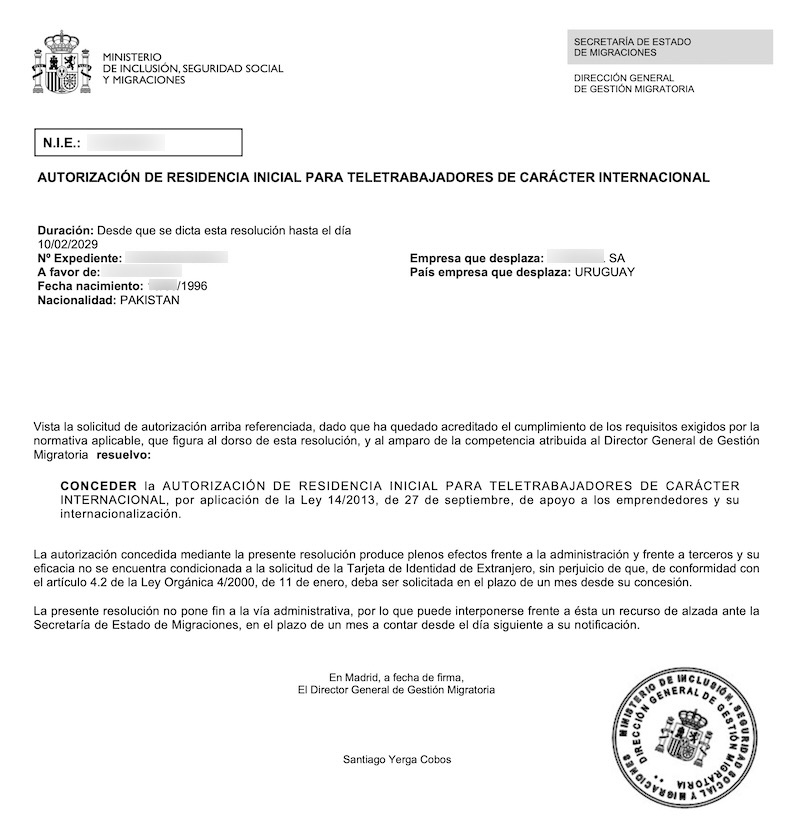
The applicant, a highly qualified software engineer of Pakistani nationality, submitted an application for the Spain Digital Nomad Visa (DNV) alongside his spouse as a dependent. He was working remotely from Spain as an independent contractor for a commercial entity based in Uruguay.
While his professional qualifications and personal freelancer status were thoroughly documented, a complex bureaucratic roadblock arose regarding the corporate documentation of his client company.
The Spanish Unidad de Grandes Empresas (UGE) strictly requires official proof that a client company has maintained active registration and real commercial operations for at least one year. However, Uruguay does not issue a standardized “certificate of good standing” or a single explicit continuous-activity document for businesses. This lack of a direct local equivalent risked stalling both the main applicant’s case and his spouse’s linked application.
The Strategy & Solution
To confidently satisfy the UGE’s strict compliance standards without a direct single certificate, our team structured a multi-layered evidentiary approach accompanied by a detailed legal explanation letter. We thoroughly explained to the evaluator that under Uruguayan commercial law, corporate status is verified cumulatively rather than through a single administrative registry.
We compiled and submitted a comprehensive compliance bundle consisting of three mutually reinforcing, apostilled documents:
- Registro Nacional de Comercio (RNC): The official commercial registry certificate proving the corporate constitution, bylaws, and registered directors.
- Notarial Certificate and Testimony: Officially verified documentation validating the company’s continuous legal existence and active status.
- Comprehensive Explanation Letter: A signed brief drafted by our team clarifying the nuances of Uruguayan corporate regulations to bridge the administrative gap for the Spanish evaluator.
The Outcome
By proactively untangling the foreign corporate framework and presenting an unassailable bundle of authenticated local alternatives, our team successfully satisfied the UGE’s operational verification requirements.
On February 11, 2026, both applications were officially Approved! The software engineer received his primary residency authorization, and his spouse was simultaneously granted her dependent residency. Both authorizations are valid through February 10, 2029, ensuring long-term peace of mind for the couple as they begin their journey together in Spain.
This case highlights that when foreign company records do not fit perfectly into standard Spanish administrative boxes, an expert understanding of international corporate structures can keep both primary and family applications entirely on track.
Want the same outcome?
Tell us about your case and we'll map out the fastest route to approval.