
- Applicants
- Lone applicant
- Nationality
- Indian
- Client’s Company
- India
- Applied From
- Within Spain
- Submission Date
- January 30, 2026
- Resolution Date
- March 4, 2026
The Case & Challenge
The applicant, an Indian Technical Lead, applied for Spain’s Digital Nomad Visa from within Spain while working remotely as a freelancer for a company based in India.
He had been providing services to the company since May 2022, handling technical leadership, software development, API integrations, code review, deployment support, and other technology-related responsibilities. His agreement specifically defined the arrangement as freelance and authorized him to perform his services remotely from anywhere in the world.
During the processing of his application, UGE issued a requerimiento asking him to prove that he had been officially registered as self-employed in India for at least three months.
Importantly, the requerimiento acknowledged that some countries do not maintain a dedicated self-employed workers’ registry. In those cases, UGE allowed alternative evidence such as tax registration, independent social security registration, business licenses, tax returns, GST payment records, or registration as a sole proprietor.
This became the key issue in the application because India does not have a self-employed workers’ registry equivalent to Spain’s RETA system.
The Strategy & Solution
Instead of trying to obtain a certificate that does not exist within the Indian system, we responded using the applicant’s GST registration as official evidence of his independent economic activity.
We submitted his GST Registration Certificate (Form GST REG-06), duly apostilled and accompanied by its sworn Spanish translation.
Alongside the certificate, we prepared a concise explanation for UGE outlining how self-employed professionals and individual business operators are registered within India’s tax system. We explained that GST registration serves as an official fiscal registration for carrying out independent economic activity.
There was also an important detail that strengthened the response: the applicant’s GST registration had been active since February 14, 2018. This demonstrated a continuous registration period far exceeding the minimum three months specifically requested by UGE.
The response therefore focused not simply on submitting another document, but on showing why the GST certificate was the appropriate Indian evidence for the requirement UGE was trying to verify.
The Outcome
UGE accepted the documentation and explanation submitted in response to the requerimiento.
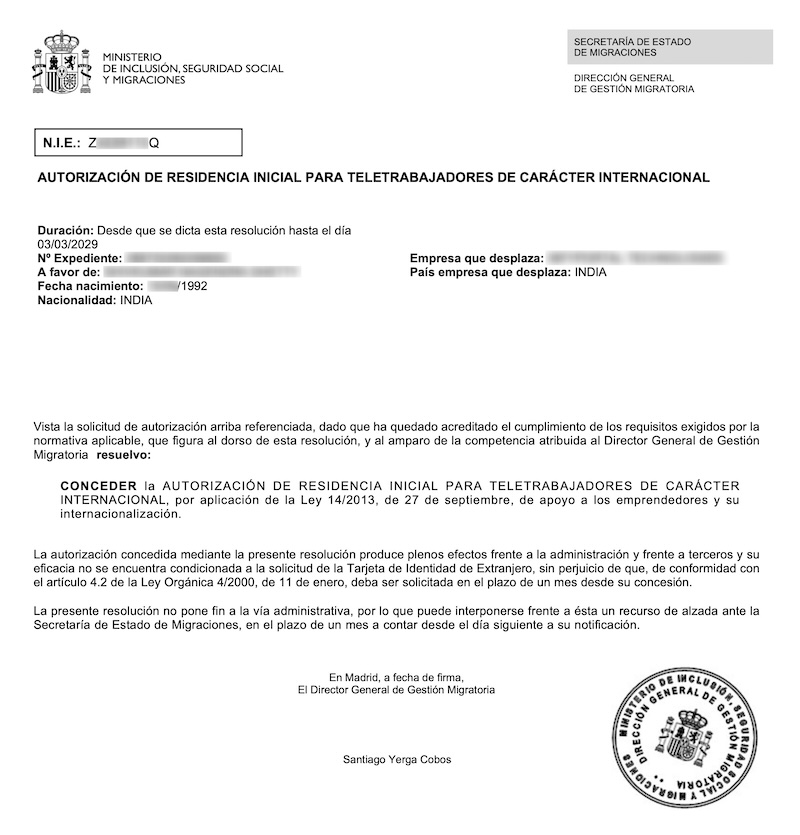
On March 4, 2026, the applicant’s Initial Residence Authorization for International Teleworkers was approved, with validity until March 3, 2029.
This case was very similar to another Indian freelancer application we handled, but it reinforces an important point: when a country does not issue the exact document requested by UGE, the solution is to identify the official local equivalent and clearly explain how it satisfies the requirement.
In this case, the applicant’s long-standing GST registration provided exactly the evidence needed. By submitting the certificate with the proper apostille and sworn translation, together with a focused explanation of India’s registration system, we were able to resolve the requerimiento and secure his three-year Spain Digital Nomad Visa approval.
Want the same outcome?
Tell us about your case and we'll map out the fastest route to approval.