
Approved
Filipino Senior Software Engineer (Client Companies in Utah and New Jersey, USA)
- Applicants
- Lone applicant
- Nationality
- Filipino
- Client’s Companies
- Utah and New Jersey, USA
- Applied From
- Spain
- Submission Date
- August 12, 2026
- Resolution Date
- September 7, 2026
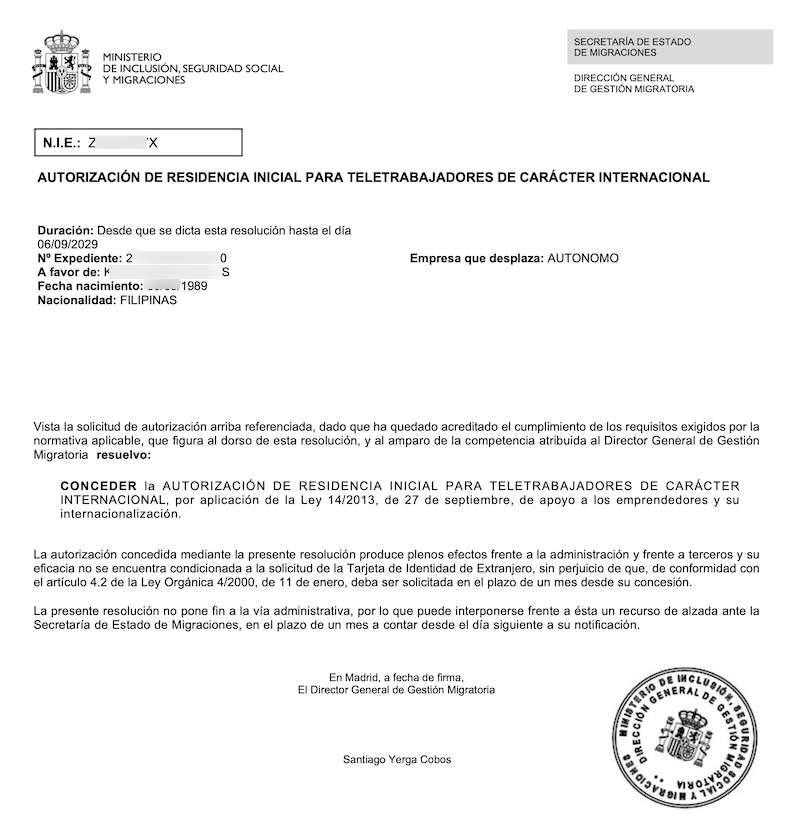
The Case & Challenge
The applicant, a Filipino Senior Software Engineer with more than ten years of professional experience, applied for Spain’s Digital Nomad Visa from within Spain as a self-employed international teleworker. His work covered full-stack development, mobile applications, embedded systems, and technical leadership for overseas clients.
His application was based on independent professional relationships with two companies in the United States, located in Utah and New Jersey. One relationship dated back to December 2017, while the other began in November 2023. Both companies authorized him to continue performing his work remotely from Spain.
With more than one client and different payment arrangements, the file needed to present a clear picture of his professional activity: the ongoing contracts, the work performed remotely, the companies behind those contracts, and the income received.
The Strategy & Solution
We submitted the application electronically through UGE on August 12, 2026, while the applicant held a valid stay authorization in Spain. The file brought together his independent contractor agreements and updated company letters explaining his roles, compensation, and express authorization to work remotely from Spain.
The foreign companies’ legal existence and standing were supported by official US company certificates, apostilled and sworn-translated into Spanish. These records documented the businesses in Utah and New Jersey without relying solely on informal company statements.
The application also included three months of bank statements, payment records, and evidence of his independent work. His agreements and company letters explained the payment arrangements, including international transfers processed through a payment platform, so the contractual relationships could be understood alongside the financial records.
His professional background was supported by his university qualification and résumé. The submission also included his passport, proof of entry into Spain, criminal record documentation and the accompanying responsible declaration, the application form and fee-payment evidence, and the designation of a representative.
Because he applied as an independent contractor rather than as an employee remaining under foreign social security coverage, the file included a commitment to register as an autónomo in Spain and contribute through the appropriate Spanish social security regime.
The Outcome
The signed resolution was issued on September 7, 2026, granting the applicant his Initial Residence Authorization for International Teleworkers, valid until September 6, 2029.
The approval allowed him to reside in Spain while continuing his remote professional activity for his overseas clients. Following approval, the next steps include completing the required autónomo registration and applying for his residence card (TIE).
This case shows how a self-employed Digital Nomad Visa application can bring together multiple long-term client relationships in one coherent file. Clear contracts, explicit remote-work permission, official company records, and financial evidence helped document the applicant’s professional circumstances. Each application is assessed individually; this approval does not guarantee the same outcome for another applicant.
Want the same outcome?
Tell us about your case and we'll map out the fastest route to approval.
More approvals
American Business Development Manager (Client Company in Virginia, USA)
American · Company in United States
Filipino Finance Consultant (Client Company in the United Arab Emirates)
Filipino · Company in United Arab Emirates
Pakistani Managing Partner (Client Company in Delaware, USA)
Pakistani · Company in United States