
- Applicants
- Main applicant + spouse and child dependents
- Nationality
- Pakistani
- Client’s Company
- Delaware, USA
- Applied From
- Spain
- Initial Submission Date
- March 9, 2026
- Reapplication Date
- April 7, 2026
- Resolution Date
- May 12, 2026
The Case & Challenge
The applicant, a Pakistani Managing Partner providing remote software development, technical leadership, and consulting services to a company registered in Delaware, USA, applied for Spain’s Digital Nomad Visa from within Spain. His professional services agreement had been in place since July 2023, and the company expressly authorized him to continue working remotely from Spain.
The initial application was submitted on March 9, 2026. The file included a declaration of entry issued by the police at Madrid airport, alongside his professional agreement, income evidence, qualifications, company documentation, and other supporting records.
He applied together with his spouse and their young child: their family applications were submitted the same day, each linked to his file as the principal applicant.
Despite having that police-issued document, the application was rejected because UGE could not verify the declaration of entry in the central immigration register. The resolution stated that this prevented verification of his effective entry date and his regular status in Spain when he applied. The problem was not a missing declaration in the submitted file, but a discrepancy between the document he held and what UGE could find in the system.
After receiving the rejection, the applicant returned to the police at Madrid airport. The police told him that the declaration was already in the system, leaving him caught between two conflicting administrative accounts.
The Strategy & Solution
Rather than relying on the same declaration alone, we submitted a new application on April 7, 2026 with additional evidence of his entry and stay in Spain. This strengthened the documentary record of his presence in the country and directly addressed the issue raised in the first refusal.
His family's applications fell with his and were restarted the same way. When the principal's application was denied, both his spouse's and child's applications were denied the same day, each for one reason: the denial of the residence authorization of the linked principal applicant. New family applications were filed alongside his reapplication on April 7, 2026, again linked to him — because his approval was the foundation for theirs.
The new application then received a detailed requerimiento. UGE requested authorization for the legal representative and further evidence of the business activity behind the application. Because the applicant had effective control of the company and management responsibilities, the reviewer asked for documentation supporting that business structure rather than treating him as an ordinary salaried employee.
The request set out alternative ways to demonstrate qualifying activity: evidence of professional relationships with foreign businesses, or a package establishing the applicant’s own company’s operations. The latter included corporate registration, tax documentation, investment in productive resources, and a social security employee-history report or similar evidence.
We organized the response around real, continuous business activity. The explanatory submission, dated May 11, 2026, brought together the company’s apostilled and sworn-translated registration certificate, its US tax identification documentation, US tax records, recent business bank statements showing commercial receipts and payments, and evidence of its website, services, project portfolio, and continuing digital operations.
A key point required a clear explanation: the US company did not employ staff through a traditional US payroll. Its work was carried out through its members and independent remote collaborators, so it could not supply a US social security employee-history report for employees it did not have. We explained this operating model and supported it with alternative records, rather than leaving the requested document unexplained.
The response also included the applicant’s Pakistani tax registration and income tax returns, apostilled and sworn-translated, as complementary evidence of his declared professional activity. Each part of the package helped connect the company’s legal existence, its actual operations, and the applicant’s professional income.
The Outcome
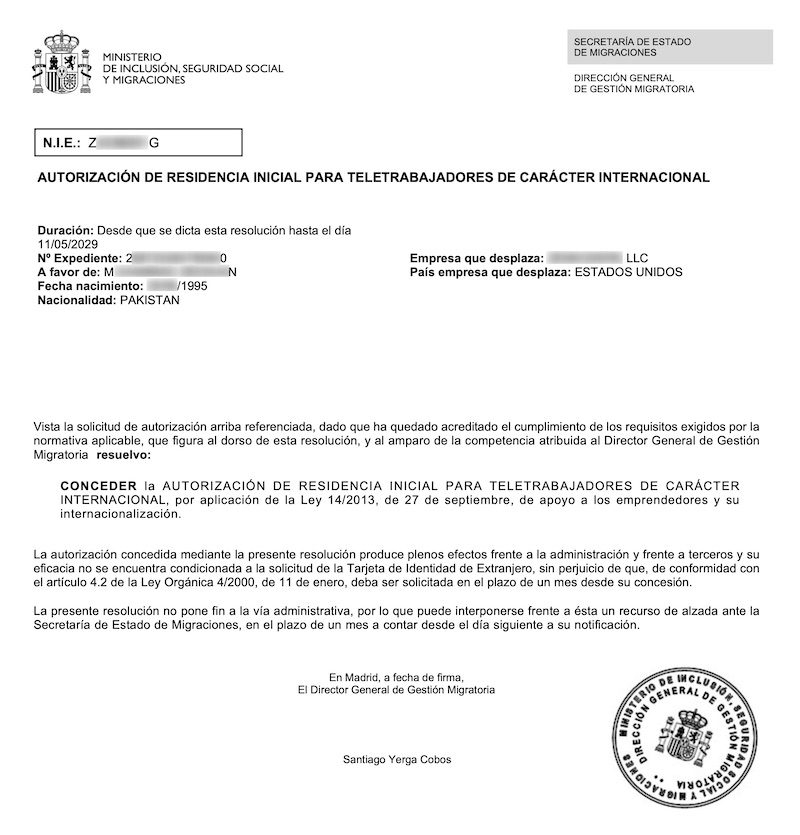
The reapplication was approved on May 12, 2026, after the additional proof of entry and stay and the business-activity response were submitted. The applicant received his Initial Residence Authorization for International Teleworkers, valid until May 11, 2029.
The approval covered the whole family. His spouse and child were approved as family members of an international teleworker, each with an authorization running until May 11, 2029, matching his permit — the child's resolution was issued on May 29, 2026.
This case involved two separate obstacles: an entry-record discrepancy that caused the first rejection, followed by a substantial request for business evidence during the new application. By addressing each issue with a focused explanation and supporting records, we helped turn a frustrating refusal into a three-year residence approval.
It also shows why a missing system record should not be confused with a client failing to obtain the underlying document, and why a company without conventional employees needs its operating model explained clearly. The evidence accepted in this case was assessed on its own facts; it is not a guarantee that the same documents will be sufficient in every application.
Want the same outcome?
Tell us about your case and we'll map out the fastest route to approval.
More approvals
American Business Development Manager (Client Company in Virginia, USA)
American · Company in United States
Filipino Senior Software Engineer (Client Companies in Utah and New Jersey, USA)
Filipino · Company in United States
Brazilian-Indian Maritime Business Consultant (Client Company in India)
Brazilian · Indian · Company in India