
Approved
Kyrgyz Sales and Finance Officer (Client Company in the United Arab Emirates)
- Applicants
- Lone applicant
- Nationality
- Kyrgyz
- Client’s Company
- United Arab Emirates
- Applied From
- Spain
- Submission Date
- September 14, 2026
- Resolution Date
- October 14, 2026
The Case & Challenge
The applicant, a Kyrgyz sales and finance professional, applied for Spain’s Digital Nomad Visa from within Spain while holding a valid stay authorization. She provided services as an independent contractor for a real estate company in the United Arab Emirates. Her work covered sales coordination, client relationship management, financial reporting support, invoicing, and payment follow-up — duties that could be carried out remotely.
Her professional relationship with the company had been continuous since April 2025. An updated services agreement effective in June 2026 set out her current compensation and confirmed that it continued the existing relationship rather than starting a new one. The company also supplied a remote-work authorization letter confirming her role, duties, remuneration, and permission to work remotely.
We submitted the application electronically through UGE on September 14, 2026. During processing, UGE issued a requerimiento — a request to correct or supplement the documentation — dated October 9, 2026. The issue concerned the academic qualification and criminal record documentation, specifically the electronic signatures on their sworn Spanish translations.
The Strategy & Solution
The initial application included the services agreement and remote-work letter, company registration records, bank statements and invoices, academic and professional-experience evidence, and her résumé. It also included her passport, proof of entry into Spain, criminal record documentation, the accompanying responsible declaration, application and fee-payment documents, representation authorization, and a commitment to register as an autónomo in Spain.
The Requerimiento: Electronic Signatures on Sworn Translations
UGE requested the criminal record certificates and academic qualification, duly legalized or apostilled as applicable, with sworn Spanish translations. It specified that the translations needed an electronic signature that could identify the translator through VALIDe, the government’s electronic-signature verification service. According to the request, checking the documents previously supplied had returned an invalid signature-format result.
This was a documentation and signature-verification issue, not a refusal of the application. The response needed to address the exact files UGE was unable to validate, rather than simply repeat the applicant’s eligibility arguments.
In a response dated October 13, 2026, we addressed the three relevant documents individually:
- The academic qualification from Kyrgyzstan: an updated file containing the original academic documentation, notarization, apostille, and sworn Spanish translations of the diploma, notarial certification, and apostille.
- The Kyrgyz criminal record certificate: the original documentation with its apostille and sworn Spanish translation.
- The UAE criminal record certificate: the certificate with legalization by the UAE Ministry of Foreign Affairs and the Spanish Embassy, together with its sworn Spanish translation.
The response supplied these as three separate electronic PDF files, preserving the sworn translator’s existing electronic signatures. An accompanying explanation identified the documents and asked UGE to check the attached electronic files in VALIDe to verify the signatures and the translator’s identity. This directly addressed the signature-format problem described in the requerimiento.
The Outcome
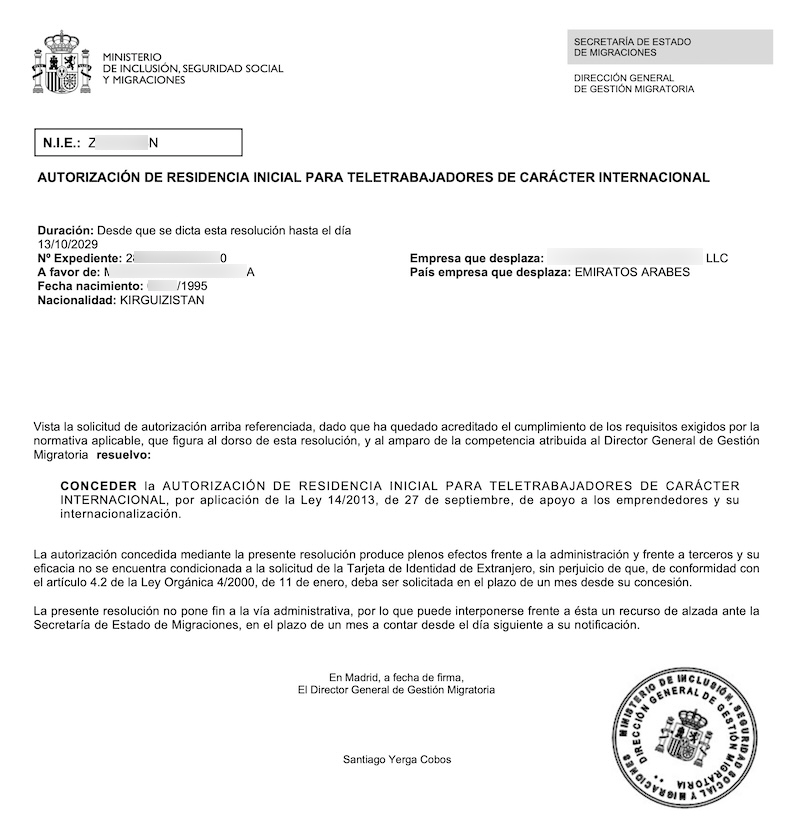
The application was approved on October 14, 2026, following the response dated the previous day. The signed resolution granted an Initial Residence Authorization for International Teleworkers valid until October 13, 2029. The story’s publication date is the signed approval date, not the submission or requerimiento date.
Following approval, the next steps include completing the required autónomo registration and applying for the residence card (TIE).
This case highlights why a requerimiento should be answered precisely: the documents’ content was only part of the picture; the format of the electronically signed translations also mattered. A focused explanation and separately supplied electronic files helped resolve the issue and move the application forward. Each application is assessed individually, and this outcome does not guarantee approval in another case.
Want the same outcome?
Tell us about your case and we'll map out the fastest route to approval.
More approvals
American Business Development Manager (Client Company in Virginia, USA)
American · Company in United States
Filipino Senior Software Engineer (Client Companies in Utah and New Jersey, USA)
Filipino · Company in United States
Filipino Finance Consultant (Client Company in the United Arab Emirates)
Filipino · Company in United Arab Emirates