
- Nationality
- United States
- Applicants
- Main applicant + spouse dependent
- Client's Company
- United States
- Professional Arrangement
- Full-time employee
- Submission Date
- July 11, 2026
- Resolution Date
- September 22, 2026
The Case & Challenge
The applicant, an American CFO and client consultant, applied for Spain’s Digital Nomad Visa from within Spain together with his spouse dependent. He works as a full-time employee — not a self-employed contractor — for an information technology consulting company in Ohio, United States.
The employer confirmed that his employment dates back to April 2016. His responsibilities include financial reporting, client consulting on inventory accounting systems, and systems integration to support data flows. The role is performed entirely through digital means, without requiring his physical presence at the company’s premises or client sites. The company expressly authorized him to work remotely from Spain while maintaining his existing responsibilities.
Both applications were submitted through UGE on July 11, 2026, with the spouse’s application linked to the main applicant’s file. The challenge was the lack of an express decision within the legal processing deadline, rather than a documented refusal.
The Strategy & Solution
The employee’s supporting documents included his employment agreement and the employer’s remote-work authorization letter, together with an apostilled and sworn-translated Ohio certificate of good standing confirming the company’s incorporation in 2000.
A key part of this employee-based application was the certificate of coverage issued by the US Social Security Administration under the US–Spain Social Security agreement, accompanied by its sworn Spanish translation. It documented his continued coverage under US legislation for the certified period. This was an employee application supported by the applicable coverage certificate, not an autónomo application; the certificate’s scope and conditions remain relevant to his ongoing compliance.
The spouse’s linked application included the marriage certificate, passport, health insurance, criminal record documentation and responsible declaration, proof of entry into Spain, application and fee-payment documents, and representative designation.
Positive Administrative Silence
When the legal deadline passed without notification of an express decision, we pursued positive administrative silence. A request dated August 14, 2026 asked UGE to recognize the main application’s approval by silence, issue the corresponding certificate, and provide an express favorable resolution.
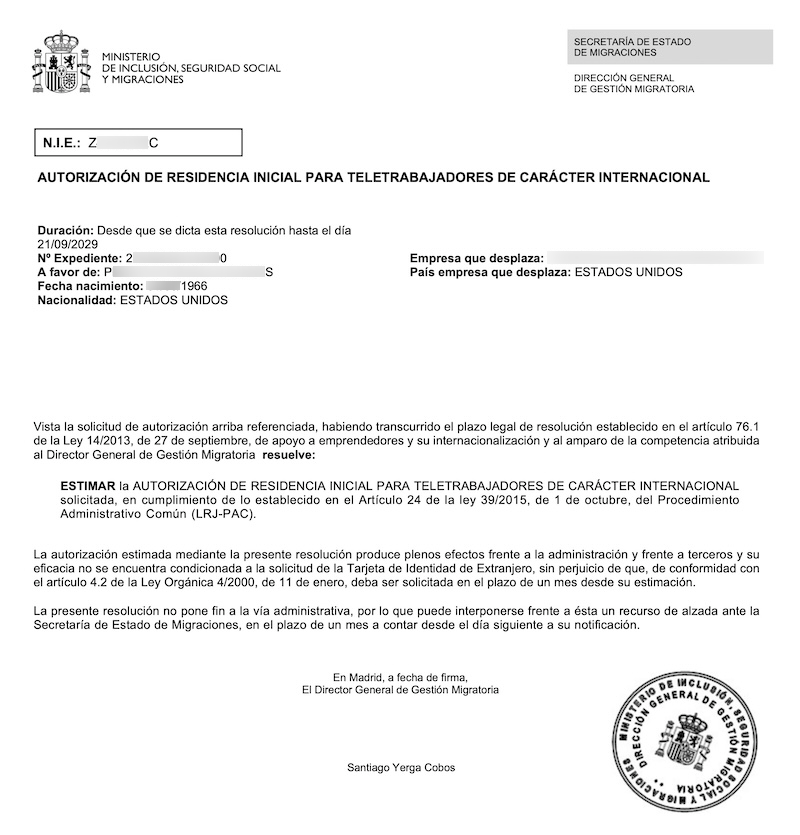
The eventual resolutions for both applicants expressly recognized the applications as approved after the legal decision period had elapsed, referring to Article 24 of Law 39/2015. The request for recognition was part of obtaining documentary confirmation of the outcome; its date was not the story’s approval or publication date.
The Outcome
The main applicant’s residence approval was signed on September 22, 2026, as recorded in the official signature report. His spouse’s linked residence approval was signed on September 23, 2026. Both authorizations are valid until September 21, 2029.
The story is published using September 22, 2026, the main applicant’s signed resolution date. The image shown above is his approval resolution; the spouse’s separate resolution confirms her linked approval.
The next step for both applicants is to apply for their residence cards (TIE). His ongoing work remains based on his employment relationship and the applicable Social Security coverage arrangements, rather than a change to self-employed status.
This case illustrates a successful employee-and-spouse application in which positive administrative silence was followed by formal approval documentation. Each application is assessed individually, and the outcome does not guarantee approval or identical Social Security treatment in another case.
Want the same outcome?
Tell us about your case and we'll map out the fastest route to approval.