
- Nationality
- Pakistan
- Applicants
- Lone applicant
- Client's Company
- Qatar
- Professional Arrangement
- Independent contractor (self-employed)
- Submission Date
- September 21, 2026
- Resolution Date
- October 16, 2026
The Case & Challenge
The applicant, a Pakistani finance and accounting consultant, applied for Spain’s Digital Nomad Visa from within Spain while holding a valid stay authorization. He works as an independent contractor for a hospitality company in Qatar, a professional relationship in place since January 2026. His services cover financial and management reporting, budgeting and forecasting, financial analysis, accounts receivable and payable oversight, reconciliations, month-end and year-end closing support, and coordination with auditors — all performed remotely.
He invoices the company a fixed monthly professional fee, paid by bank transfer. The company’s remote-work authorization letter confirmed his role, duties, remuneration, and express permission to perform all services from Spain, with no obligation to attend a physical office.
We submitted the application electronically through UGE on September 21, 2026. During processing, UGE issued a requerimiento — a request to correct or supplement the documentation — dated October 13, 2026, with five separate points to address.
The Strategy & Solution
The initial file brought together the independent professional services agreement, the company’s remote-work authorization letter, three months of bank statements evidencing his professional income, invoices, his university degree and résumé, and proof of entry into Spain. It also included criminal record documentation with the accompanying responsible declaration, the application form and fee-payment evidence, representative designation, and a commitment to register as an autónomo in Spain.
The Requerimiento: Five Points to Answer
UGE’s request covered five distinct items:
- Qatar criminal record certificate: because he had resided in Qatar for the last two years, the certificate had to be legalized and sworn-translated — and the sworn translation’s electronic signature had to be verifiable in VALIDe, the government’s signature-verification service. The previously supplied file had returned an invalid signature-format result.
- Proof of residence in Qatar: his Qatar residence card, or alternatively a Pakistani criminal record certificate if he had resided in Pakistan.
- Company seniority: an official commercial registry certificate proving the company had been incorporated for at least one year, legalized and sworn-translated.
- Qualification or experience: a university degree or proof of at least three years of professional experience, apostilled and sworn-translated.
- Self-employed registration: proof of registration as a self-employed worker in his country of origin for at least the last three months — or, where no such registry exists, an accepted alternative such as a tax registration certificate.
In a response dated October 15, 2026, we answered every point: the Qatar criminal record certificate with its legalizations and the original electronically signed sworn-translation PDF, verifiable in VALIDe; his Qatar residence permits for 2024, 2025, and 2026 with sworn translations; the company’s commercial registry certificate showing incorporation in 2010, legalized by the Qatari Ministry of Foreign Affairs and the Spanish Embassy in Doha; his apostilled Bachelor of Commerce degree; and his Pakistani taxpayer registration certificate, apostilled and sworn-translated, as the officially accepted alternative to a self-employed registry that does not exist in Pakistan. The response mapped each document to the exact point it answered.
The Outcome
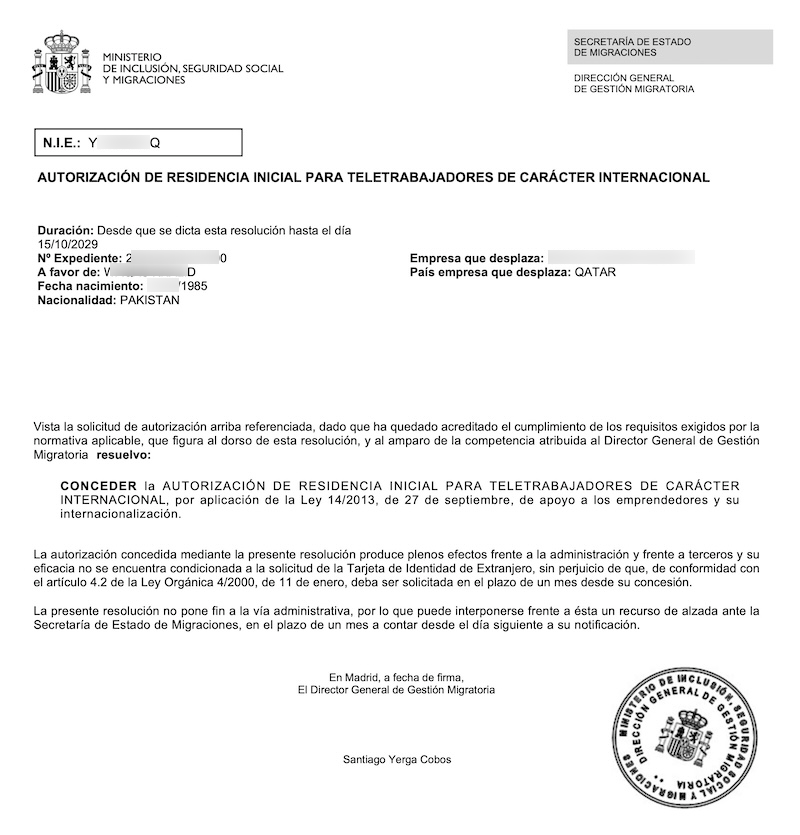
The application was approved on October 16, 2026, the day after the response was filed. The signed resolution granted an Initial Residence Authorization for International Teleworkers valid until October 15, 2029. The story’s publication date is the signed approval date, not the submission or requerimiento date.
Following approval, the next steps include completing the required autónomo registration and applying for the residence card (TIE).
This case shows that a multi-point requerimiento is not a refusal: each requested item had a clear, documentable answer, and responding point by point — including using the regulation’s own alternative for countries without a self-employed registry — moved the file to approval within days. Each application is assessed individually, and this outcome does not guarantee approval in another case.
Want the same outcome?
Tell us about your case and we'll map out the fastest route to approval.