
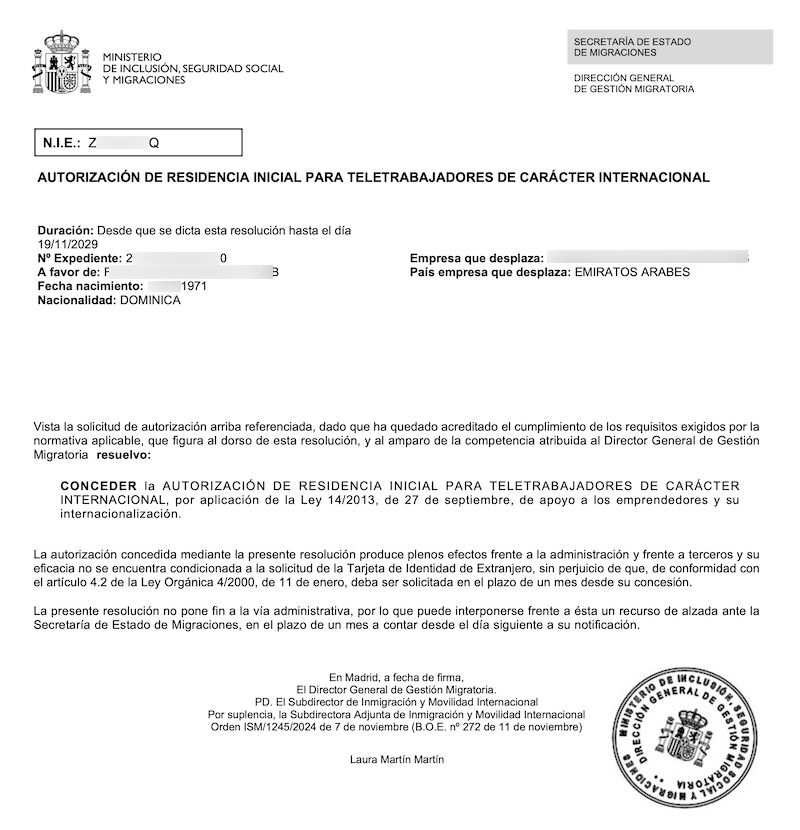
Approved
Dominican Design Consultant (Client Company in the United Arab Emirates)
- Nationality
- Dominica
- Applicants
- Lone applicant
- Client's Company
- United Arab Emirates
- Professional Arrangement
- Independent contractor (self-employed)
- Submission Date
- October 20, 2026
- Resolution Date
- November 20, 2026
The Case & Challenge
The applicant, a design consultant from Dominica, applied from Spain for the Digital Nomad residence authorization. He provides remote professional services to a company in the United Arab Emirates as an independent contractor, rather than an employee.
The company’s authorization letter confirmed an ongoing five-year service agreement beginning in July 2025 and expressly permitted him to work remotely from Spain. His responsibilities include managing the design, review, and approval process, communicating by phone, email, and video calls, and reporting remotely to the company’s management.
The application included his service contract, remote-work authorization, bank statements, invoices, company registration evidence, academic qualification, CV, criminal record certificates, evidence of entry into Spain, and a commitment to register as an autónomo. The main challenge arose when UGE requested corrections to the authentication of foreign supporting documents.
The Strategy & Solution
We submitted the application electronically through UGE on October 20, 2026. On November 12, 2026, UGE issued a requerimiento identifying two areas that needed further documentation:
- Professional qualifications: UGE stated that the academic document already provided was not properly apostilled or legalized. It requested the original qualification or evidence of at least three years of relevant professional experience, properly authenticated and accompanied by a sworn Spanish translation.
- Criminal record certificates: UGE stated that the certificates provided were not properly apostilled or legalized and requested authenticated certificates with sworn Spanish translations.
The response letter, dated November 19, 2026, addressed both points with clearly organized documents:
- A certificate issued by the UAE’s Ministry of Human Resources and Emiratisation (MOHRE), documenting more than 11 years of professional experience, legalized by the UAE Ministry of Foreign Affairs and authenticated by the Spanish Embassy in the UAE.
- The academic qualification, also legalized by the UAE Ministry of Foreign Affairs and authenticated by the Spanish Embassy.
- A UAE criminal record certificate following the same legalization and embassy-authentication process.
- An apostilled criminal record certificate from Dominica.
These documents were accompanied by sworn Spanish translations with digital signatures. The response also clarified the applicant’s Dominica nationality and longstanding residence in the UAE. Our apostille and translation guide explains the distinction between apostilles and diplomatic legalization when preparing a DNV file.
The Outcome
The approval resolution was signed on November 20, 2026, granting the applicant international teleworker residence authorization valid until November 19, 2029. The story’s publication date follows that signed approval date.
This case highlights the importance of properly authenticating foreign public documents: providing a qualification or police certificate alone may not be enough if the required apostille or legalization is missing. The response addressed the deficiencies identified by UGE and supported the applicant’s qualifications with both academic and professional-experience evidence.
Following approval, the applicant can proceed with TIE card formalities and the applicable autónomo registration. Every application is assessed individually, and this outcome does not guarantee approval in another case.
Want the same outcome?
Tell us about your case and we'll map out the fastest route to approval.