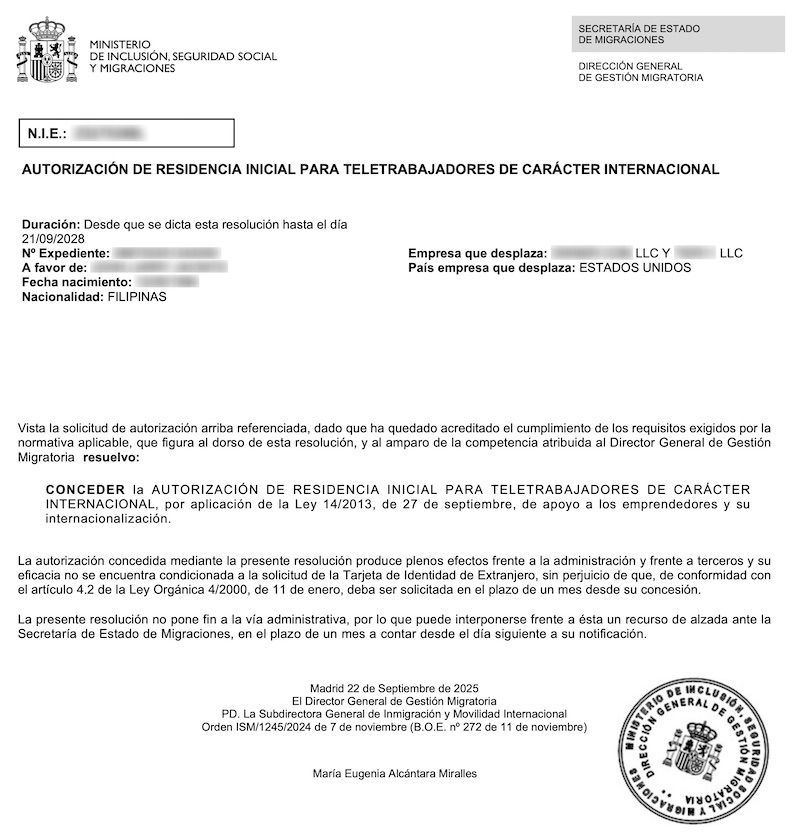
Approved
Filipino Video Editor and Consultant (Client Company in California and Massachusetts, USA)
- Nationality
- Philippines
- Applicants
- Main applicant + spouse dependent
- Client's Company
- United States
- Professional Arrangement
- Independent contractor (self-employed)
- Submission Date
- September 4, 2025
- Resolution Date
- September 22, 2025
The Case & Challenge
The applicant, a Filipino video editor and consultant, provides remote services to two companies based in California and Massachusetts, United States. Both relationships are independent contractor arrangements, rather than employment. His work involves end-to-end video editing and collaboration with marketing teams to meet brand guidelines and performance objectives.
He initially applied for a Digital Nomad Visa through the Spanish Consulate in the Philippines together with his wife. He received a one-year visa, but his wife's application was rejected. The earlier application had included income evidence from only one of his two client companies, leaving an incomplete picture of the income available to support the couple.
After he arrived in Spain, we prepared a new application for Digital Nomad residence authorization, alongside his spouse's dependent application. The key was to document both ongoing professional relationships and their combined income clearly.
The Strategy & Solution
The applications were submitted on September 4, 2025. The main applicant's supporting file brought together:
- Two independent contractor agreements: The California client relationship began in June 2023, while the Massachusetts client relationship began in August 2024. The agreements documented his video-editing services and contractor status.
- Remote-work authorization from both companies: Each letter expressly supported him continuing his contractual work from Spain and confirmed his duties, relationship start date, and remuneration.
- The complete income picture: The authorization letters stated monthly remuneration of $4,050 from the California client and $1,440 from the Massachusetts client, totaling $5,490 per month. This documented both income sources rather than relying on just one.
- Company registration and good-standing evidence: Certificates from California and Massachusetts confirmed the companies' registered status. Both were accompanied by apostilles and sworn Spanish translations.
- Sworn Spanish translations: The contracts and remote-work letters were also provided with their official translations, keeping the professional arrangements and supporting evidence clear for UGE.
For applicants preparing similar documents, our apostille and sworn translation guide explains how to organize foreign supporting records.
The Outcome
The main applicant's residence authorization was signed on September 22, 2025 and is valid until September 21, 2028. This story is published on that signed approval date.
His spouse's approval came later, on October 1, 2025. Her application required additional representation documentation, including an apostilled Special Power of Attorney, before it was approved. Her separate spouse-dependent success story covers that part of the process.
This case shows why applicants with multiple overseas clients should present the complete set of contracts, remote-work permissions, company records, and income evidence, especially when applying with dependents. Approval of the main applicant does not mean a dependent's decision will arrive at the same time.
Following approval, the main applicant can complete the TIE card process and the applicable autónomo registration. Every case is assessed individually; this outcome does not guarantee approval for another applicant.
Want the same outcome?
Tell us about your case and we'll map out the fastest route to approval.
More approvals
Dominican Design Consultant (Client Company in the United Arab Emirates)
Dominica · Company in United Arab Emirates
Indian Software Tester (Client Company in the Philippines)
India · Company in Philippines
Pakistani Marketing Consultant (Client Company in Georgia, USA)
Pakistan · Company in United States