
Approved
Pakistani Senior Frontend / Full-Stack Developer (Client Company in Washington, USA)
- Nationality
- Pakistan
- Applicants
- Main applicant + spouse and minor child dependents
- Client's Company
- United States
- Professional Arrangement
- Independent contractor (self-employed)
- Submission Date
- August 10, 2026
- Resolution Date
- September 2, 2026
The Case & Challenge
The main applicant, a Pakistani senior frontend and full-stack developer, applied for Spain’s Digital Nomad residence authorization from Spain with his spouse and minor child as dependents. All three family members are Pakistani nationals.
He provides remote software-development services to a United States company with an office in Washington. His work includes developing web and mobile applications, building frontend and full-stack solutions, and collaborating with remote teams on enterprise software and AI-driven projects.
The company’s remote-work letter confirmed an ongoing independent contractor relationship dating back to December 2022 and expressly authorized him to continue working from Spain. Although the older contract used employment terminology, the current authorization letter described independent professional services, and the residence application was supported by a commitment to register as an autónomo.
The Strategy & Solution
We submitted the main application electronically through UGE on August 10, 2026. The supporting documents established the ongoing professional relationship, remote nature of the work, qualifications, and income:
- The contract and remote-work authorization documented his role and permission to perform his duties from Spain.
- A remuneration-increase letter confirmed the updated monthly income, alongside the company’s current remote-work letter and the income evidence listed in the submission.
- An apostilled company good-standing certificate with a sworn Spanish translation documented the United States company’s legal existence.
- The file also included his university qualification, CV, bank and payment records, criminal record certificates, entry evidence, fee-payment documents, proof of self-employed work, and a commitment to register as an autónomo in Spain.
Relevant foreign-language documents were accompanied by sworn Spanish translations. Our apostille and translation guide explains the preparation of these supporting documents.
The Outcome: Main Approval First, Dependents Much Later
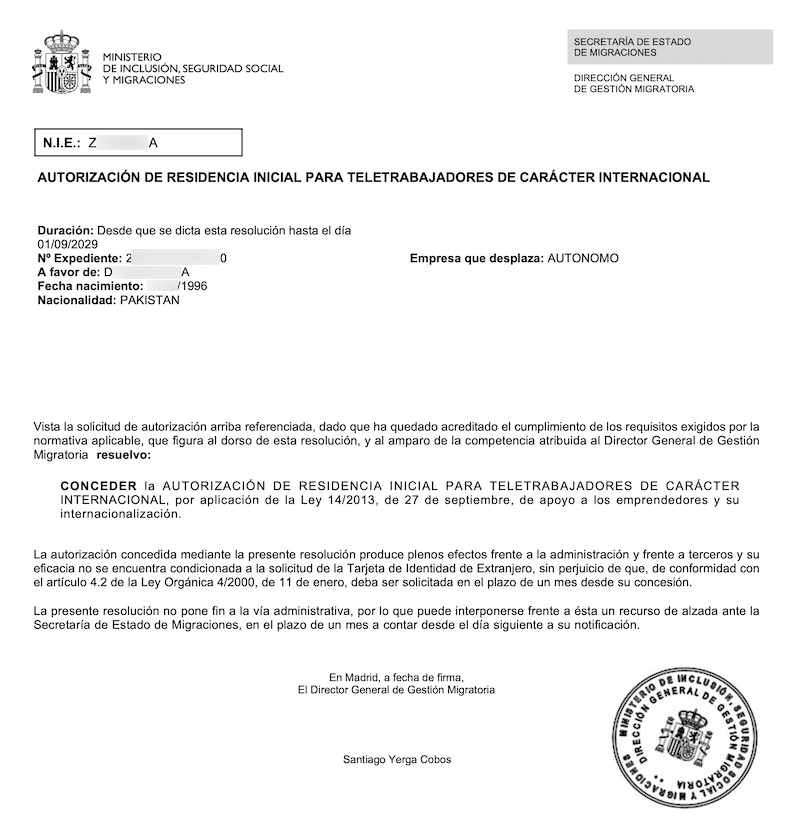
The main applicant’s approval resolution was signed on September 2, 2026. His residence authorization is valid until September 1, 2029. The signed approval date—not a date inferred from the expiry—is this story’s publication date.
The dependents’ approvals came much later: both the spouse’s and the minor child’s resolutions were signed on November 7, 2026, more than two months after the main applicant’s approval.
Both dependent resolutions recognize positive administrative silence, expressly noting that the legal decision period had elapsed. Their authorizations are linked to the main applicant’s and share the same September 1, 2029 expiry date. Learn more in our guide to positive administrative silence.
The result was approval for all three family members, but not at the same time. This case highlights why families should track each application separately rather than assume that a main applicant’s approval means the dependents’ resolutions have also arrived.
With their resolutions issued, the family can proceed with their TIE card formalities, while the main applicant completes the applicable autónomo registration. Each application is assessed individually, and this outcome does not guarantee approval in another case.
Want the same outcome?
Tell us about your case and we'll map out the fastest route to approval.
More approvals
Dominican Design Consultant (Client Company in the United Arab Emirates)
Dominica · Company in United Arab Emirates
Indian Software Tester (Client Company in the Philippines)
India · Company in Philippines
Pakistani Marketing Consultant (Client Company in Georgia, USA)
Pakistan · Company in United States